What is Compostable Food Packaging? The Ultimate Breakdown Guide (2026)
The terms “biodegradable” and “compostable” are often used interchangeably, causing massive confusion. Many wholesalers are wary of “greenwashing.” To make informed choices, it’s crucial to understand the science behind Compostable Food Packaging.
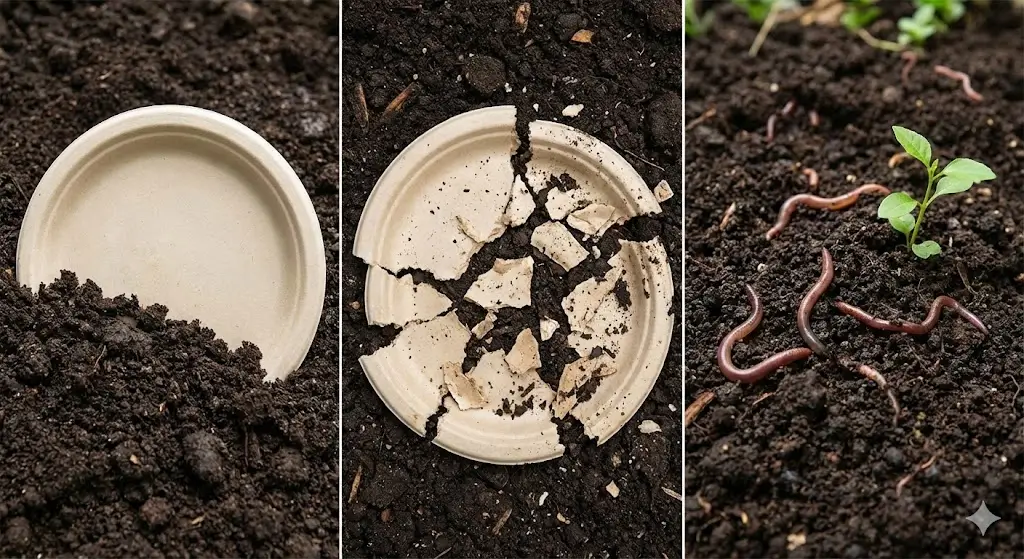
What actually happens to a bagasse plate when it’s discarded? Does it just disappear? In this guide, EcoTable demystifies the composting journey and explains why Compostable Food Packaging is the future.
Table of Contents
- 1. Biodegradable vs. Compostable Food Packaging
- 2. The 90-Day Journey: How It Breaks Down
- 3. Why Certifications Matter
- 4. The Danger of “Oxo-Degradable” Plastics
- 5. Frequently Asked Questions
- Conclusion
1. Biodegradable vs. Compostable Food Packaging
These are not the same thing. Understanding the difference is vital for compliance:
- Biodegradable: Means it will eventually break down naturally, but it could take years and might leave microplastics behind. Even regular plastic is technically “biodegradable” over 500 years.
- Compostable: This is the gold standard. Compostable Food Packaging breaks down into organic, non-toxic matter (compost) within a specific timeframe (usually 90-180 days). True Compostable Food Packaging leaves zero trace.
2. The 90-Day Journey: How It Breaks Down
Sugarcane bagasse is organic plant fiber. According to Composting science (Wikipedia), here is what happens to Compostable Food Packaging in a commercial facility:
- Weeks 1-4 (Fragmentation): The high heat and moisture weaken the fiber structure.
- Weeks 5-8 (Microbial Consumption): Bacteria and fungi consume the plant fibers as food.
- Week 12 (Humus Formation): The Compostable Food Packaging has completely transformed into nutrient-rich humus (soil), ready for agriculture.
3. Why Certifications Matter for Compostable Food Packaging
How do you know it will actually compost? You must look for third-party certifications like BPI (USA) or OK Compost (EU).
These labs scientifically test Compostable Food Packaging to ensure it meets strict standards for breakdown speed and toxicity. All EcoTable products, including our bagasse plates, are fully certified.
4. The Danger of “Oxo-Degradable” Plastics
Beware of fake solutions. “Oxo-degradable” plastics are just standard plastics with additives. They do not compost; they just pollute faster by turning into microplastics. Many regions, including the EU, have banned these specifically. Always choose genuine Compostable Food Packaging made from plants, not plastic.
5. Frequently Asked Questions
Q: Can I compost Compostable Food Packaging at home?
It depends. Some items are certified “Home Compostable,” but most bagasse products break down fastest in commercial facilities with high heat.
Q: Is Compostable Food Packaging edible?
No. While it is made from plants and is non-toxic, Compostable Food Packaging is designed for holding food, not being eaten.
Conclusion
Understanding composting is key to avoiding greenwashing. True Compostable Food Packaging like sugarcane bagasse is a circular solution—from the earth, back to the earth.
EcoTable ensures all our products meet the highest international standards for Compostable Food Packaging.
See Our Certifications
Download our BPI and OK Compost certificates to verify our claims.
Interested in our eco-friendly tableware?
We provide professional B2B customization solutions. Contact us for a quote.