The Global Plastic Ban 2026: Is Your Restaurant Business Ready?
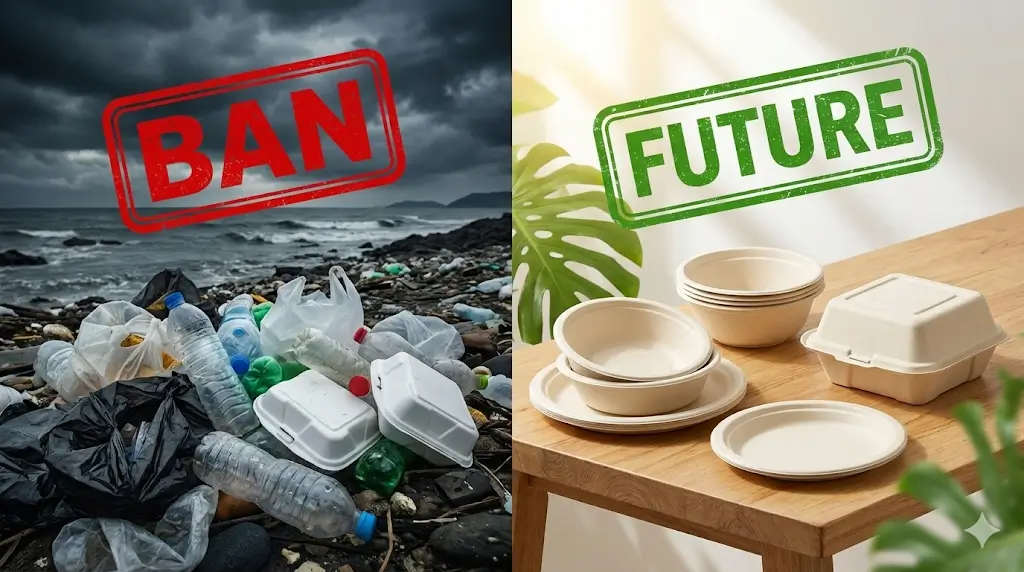
If you are in the food service industry, 2026 is a critical year. The Global Plastic Ban is no longer just a proposal—it is the law. From the strict policies in the European Union to new legislation in California and New York, governments are cracking down on single-use plastics.
For wholesalers and restaurant owners, this presents a massive risk. Sticking with Styrofoam or plastic cutlery could result in heavy fines. In this guide, EcoTable breaks down the Global Plastic Ban and shows you how to stay compliant.
Table of Contents
- 1. The European Union’s Strict Policies
- 2. The USA: State-by-State Bans
- 3. The UK and Middle East Updates
- 4. Compliant Alternatives (That Won’t Break the Bank)
- 5. Action Timeline for Wholesalers
- Conclusion
1. The European Union’s Strict Policies
The EU has been leading the Global Plastic Ban since the Single-Use Plastics Directive (SUPD) came into full effect. In 2026, enforcement is tighter than ever.
- Banned Items: Plastic cutlery, plates, straws, stirrers, and expanded polystyrene (EPS) food containers.
- The Impact: If you export to or operate in Europe, you strictly cannot use foam boxes. You must switch to certified biodegradable options like Bagasse Plates.
2. The USA: State-by-State Bans
While the US doesn’t have a single federal law, the Global Plastic Ban momentum is driven by key states:
- California: The toughest restrictions. SB 54 requires all packaging to be recyclable or compostable by 2032, with aggressive milestones in 2026.
- New York & New Jersey: Strict bans on Styrofoam containers and plastic bags are already enforced.
- Wholesaler Tip: Don’t try to stock different inventory for different states. Switch your entire supply chain to Bagasse to ensure compliance nationwide.
3. The UK and Middle East Updates
The UK implemented its ban on plastic plates and cutlery in late 2023, and 2026 sees extended producer responsibility (EPR) taxes increasing costs for plastic usage.
Surprisingly, the UAE and Saudi Arabia are also joining the Global Plastic Ban. Dubai has phased out single-use bags and is targeting food containers next. This is crucial for traders exporting to the Middle East.
4. Compliant Alternatives (That Won’t Break the Bank)
Panic is unnecessary. The market has matured, and compliant alternatives are affordable. The best substitute for banned plastic is Sugarcane Bagasse.
Banned Item Legal Alternative Why It Works Styrofoam Box Bagasse Clamshell Compostable & Sturdy Plastic Cutlery CPLA (Corn Starch) Cutlery Heat Resistant & Bio-based Plastic Plates Molded Fiber Plates Microwave Safe 5. Action Timeline for Wholesalers
To survive the Global Plastic Ban, you need a plan:
- Q1 2026: Audit your current inventory. Identify all Styrofoam and non-recyclable plastics.
- Q2 2026: Contact a direct manufacturer like EcoTable to request samples of Bagasse products.
- Q3 2026: Begin the transition. Market your new “Zero Waste” packaging to your customers as a premium upgrade.
Conclusion
The Global Plastic Ban is here to stay. It is not a burden; it is an opportunity. Businesses that adapt early will dominate the market.
EcoTable is ready to help you navigate these regulations with fully certified, BPI-compliant packaging solutions.
Stay Compliant with EcoTable
Don’t risk fines. Switch to certified legal packaging today.
Interested in our eco-friendly tableware?
We provide professional B2B customization solutions. Contact us for a quote.